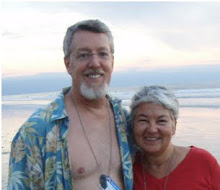
We left Chamela on March 8th. We motorsailed up the coast into light headwinds and reached Ipala by mid afternoon. Ipala is known for lobster, so we had a lobster dinner at one of the palapa restaurants, then spent the night at anchor in the bay. The next morning we continued northwest around Cabo Corrientes.
We motored with the mainsail up and drawing. By mid-morning, we faced 15 knot headwinds. The winds built as we continued and the seas around the cape became confused. It was like being in a washing machine, with heavy chop hitting us from all angles. The boat pitched fore and aft, and was slowed by the waves, but managed to cut through them without any slapping or pounding. It was a wet trip, but with assistance from the engine we were able to maintain about 5 knots of speed until we rounded the point and entered Banderas Bay.
Once in the bay, we had a couple of hours of fine sailing, close reaching into winds of about 20 knots and making good progress. We flew along with a single reef in the mainsail and the genoa slightly furled. In midafternoon, the wind suddenly became much stronger. It was whistling through the rigging at about 30 knots. The boat heeled far over and became difficult to control as it tried to round up. Because the seas were rough, I was reluctant to leave the cockpit to put in another reef. We furled the genoa and fell off to a beam reach, running with only the main. This stabilized the boat and we continued forward at about 6 knots. Waves kicked up by the strong winds broke on the deck and drenched the dodger and cockpit in spray. The winds gradually dropped as we approached La Cruz and gained some protection from the surrounding hills. By the time we reached the anchorage, the winds were moderate. The boat and crew were heavily crusted in salt.
The anchorage at La Cruz was crowded with over 40 boats and the marinas were reported to be full. A lot of people are here for a boat show and the upcoming Banderas Bay regatta. After one night in the anchorage, we were able to obtain a slip in the La Cruz marina, which was helpful because I needed to wash the salt off the boat.
We have spent the last couple of days resupplying, changing the engine oil, and getting ready to continue north. We have also spent time at the boat show and in La Cruz, still a fun town. We will continue north tomorrow.
Friday, March 12, 2010

Sunday, March 7, 2010
Back to Chamela
We have been waiting in Chamela the past three days for a "weather window" that will allow us to round Cabo Corrientes and get back to Banderas Bay. Several boats that started north from here have been forced to return by strong winds and big waves. The most recent predictions show the winds moderating tomorrow, so we'll probably make a run for it (although some of the other skippers plan to wait until next week).
While here, I took apart and reconditioned our electric windlass, which has been misbehaving. It has clutch pads, which have been slipping, making it difficult to raise the anchor. To get the clutch pads off for cleaning required removing a chain pipe and chain stripper assembly, which was bolted through the deck. Once I had the windlass disassembled, I noticed water coming from a vent in the gearbox, so I decided to drain and replace the gear oil. That required removing the entire windlass from the deck to pour out the old oil. The job took most of a day, but the windlass now seems to work much better.
At anchor near us are Richard and Roseanne Packard of the Willard 40 trawler Lilliana. When we first arrived in Bahia Chamela they were the only other boat here and they generously invited us to dinner. We learned that he is a physics professor at UC Berkeley and she is a lawyer as well as a registered nurse. It was a very interesting evening.
Richard has spent the past 17 summers on another trawler that they own in southeast Alaska. When he learned that we are heading to the northwest at the end of May, he offered to give pointers on cruising to Alaska. I spent the next afternoon going over charts and getting inspirational guidance from a true cruising veteran. It was a pleasure to learn from such an enthusiatic, generous teacher.
A high school group from Guadalajara is visiting the bay. They are spending time on the beach at one of the palapas. One of the teachers and two of the student swam out to our boat to say hello. They spoke little English, and they soon exhausted our limited Spanish, but were very friendly. The students have brought along musical instruments, including a tuba, and are now producing mariachi music with perhaps more enthusiasm than skill.
Here are two of our visitors.

Saturday, March 6, 2010
Careyes
We left Cuastecomates on March 3rd and headed up the coast. We motored in the morning because the winds were light, but by afternoon we were able to sail. The wind filled in on the beam and we had a fast run northwest to a small bay known as Careyes, where we anchored for the night.
Careyes was spectacular--the most exotic, beautiful scenery we have encountered--like a cross between Big Sur and the Italian Riviera: rocky cliffs, dark green foliage, lots of palm trees, brightly colored houses and condos built into the steep slopes, with lots of trailing flower vines and bouganvilla. There are condos and a resort on a private beach. It is definitely high end with a woo woo ambiance. There was a sweat lodge/hogan on the beach next to the massage tables enclosed in gauzy fabric, and next to that was a woman sunbathing nude. (I gave her a friendly smile, but she seemed less than delighted to see me kayak up to the beach with a camera dangling from my neck).
There was almost no one there (besides the naked lady, two teenagers in bikinis, and a couple who claimed to speak only French). There was a high-end palapa restaurant with a staff of about 12 dressed in white linen but no customers. They did seem delighted to see us, but after surveying the menu (all the usual dishes, but three times the usual prices) Claudia and I decided to pass in favor of grilling camarones on the boat.
There was also a ritzy but nearly empty hotel and lots of large, beautiful condos built into the slopes, all well maintained but mostly empty. The condos even had a funicular--I suppose to help deliver pate and champagne down from the road above.
Amazingly enough, we were the only boat there. We anchored in the tiny upper lobe of the three-lobed bay, off a pure white beach called (appropriately enough) Playa Blanca. Club Med once had a resort at Playa Blanca and much of the infrastructure (including a concrete pier and a spectacular suspension bridge from the mainland to an island) is still in place, although crumbling. The bay is tiny, with enough room for one or two boats at most.
Now, the bad parts. The old Club Med is being rebuilt (we're told as a private residential compound) and there was a huge and very noisy construction crew that worked from 8 in the morning to 8 at night. Lots of jack hammering and and what sounded like steel bars being dropped on concrete from great height. The other problem was that the tiny bay got lots of surge during the night. It was a rolly anchorage, and by morning the surge was strong enough to worry me, as we swung near rocks, so we beat a hasty retreat right after dawn and motored up to Chamela.
Here are a few pictures.


Tuesday, March 2, 2010
Cuastecomates--The "Secret" Anchorage
After leaving Barra, we headed for what cruisers call "the secret anchorage" in a small bay off the village of Cuastecomates, which is a few miles west of Melaque. It is a "secret" to cruisers because it is not described in any of the popular cruising guides. But when I told my cousin Laurie and her husband Chris about the "secret anchorage" they laughed--saying it was no secret to them; they go there all the time to swim.
As the pictures show, this bay is very pretty. We were able to swim or kayak from the boat into a nice beach that has a few palapa restaurants and hotels. Here is what the beach looks like.


Here is Claudia sampling a michelada in a beachside palapa.

And here is what I had. Sabbatical is the boat just above the bottle.

The weather is beautiful and sunsets are gorgeous.

The snorkeling is not as good here as we had been led to believe. There is a lot of sediment in the water (perhaps stirred up by the tsunami) that impairs visibility, but it is still a nice place to swim.
The second day we were here, we heard someone shouting "ahoy." I looked out and saw a woman wearing a large hat swimming toward the boat. Another woman was close behind. It turned out to be cousin Laurie, who was out swimming with her friend LizAnn. They stopped to chat for a bit before continuing on--both are impressive swimmers.
Sunday, February 28, 2010
Fuel Dock Debacle
We finally left Barra today, but before leaving the lagoon we visited the fuel dock to take on more diesel. There we had a minor disaster. The fuel dock attendant was a young woman who appeared to be about 16. After we tied our boat to the dock, the attendant handed Claudia the nozzle of the fuel hose. Claudia was about to pass the nozzle across the boat to me so I could insert it in our intake port, when the attendant turned on the high pressure pump. As it turned out, the nozzle was stuck open. It began spraying diesel all over the boat. It was pointing up at the time, so diesel sprayed all over our sails and our dodger. Claudia was taken by surprise and could not get it turned off. Eventually the attendant turned off the pump, but out boat was soaked in diesel. We spent a long time trying to clean it up with soap and water, but it was a big stinking mess. We are not happy. We'll need to be a lot more careful about refueling in the future.
Getting away from the fuel dock was also a problem. An eddy in the tidal current pushed us hard against the dock. As we backed away from the dock, the current pushed us toward the protruding stern of a large motor yacht tied to the other side of the dock We might have hit it but we were cushioned by a small inflatable dinghy that happened to be between us--a bit of good luck. We were glad to get out of there, across the bar, and out to sea again, although we did not go far. We decided to stop in a nearby bay known as "the secret anchorage." More on that later.
Getting away from the fuel dock was also a problem. An eddy in the tidal current pushed us hard against the dock. As we backed away from the dock, the current pushed us toward the protruding stern of a large motor yacht tied to the other side of the dock We might have hit it but we were cushioned by a small inflatable dinghy that happened to be between us--a bit of good luck. We were glad to get out of there, across the bar, and out to sea again, although we did not go far. We decided to stop in a nearby bay known as "the secret anchorage." More on that later.
Saturday, February 27, 2010
Surviving the Tsunami
After a month in lovely Barra at the Grand Bay Marina, we thought we were ready to leave today. We have taken on provisions for a couple of weeks, refilled our water tanks, and cleared the decks. Relying on very cheap local laborers, we have had the bottom of the boat cleaned, our fiberglass waxed, and our stainless steel polished. All seemed ready for our departure until, during a last minute check on the weather, we got the tsunami warning. A major earthquake in Chile was expected to produce tidal waves along the Pacific coast. The waves would hit Barra about 11 am. What should we do?
Most of the cruisers anchored in the lagoon decided to run out to sea. Although the waves were not expected to be large here, there was concern that tidal surge in the shallow lagoon could cause boats to hit bottom. The marina is a different matter. It is deeper and the docks are strong and secure. Most of the skippers in the marina decided to stay. We did as well. While we participated in yoga class with Sara on the beach, we watched a parade of boats from the lagoon, and a few from the marina, heading out to sea--some of them at full throttle.
At 11 am, as predicted, the surge began. There was no noticeable tidal wave, but water began to drain from the lagoon at what appeared to be an unusually rapid rate. Navigation buoys were pushed over on their sides as a strong current flowed through the narrow entrance channel. A power boat attempting a late exit through the torrent lost control while passing through the channel and collided with a big navigation buoy, breaking it off its moorings.
The rest of the afternoon there were strong surges, as if water was sloshing in and out of the lagoon. The current past our slip was strong and unpredictable--making us worry about a trip to the fuel dock. So we decided to wait another day before leaving.
Boats returned to the lagoon and marina through the afternoon. No damage was done (except to the navigation buoy). This evening we'll be toasting our survival of yet another natural disaster.
Thursday, February 25, 2010
Barra de Navidad

After nine relaxing days at Tenacatita Bay, we were ready to move on. On January 27 we made the short trip down the coast to Barra de Navidad, where we had reserved a slip at the marina of the Grand Bay Hotel--a large and luxurious resort hotel with practically no guests. Visitors at the hotel's marina are allowed to make use of all the resort amenities, including several big swimming pools connected by water slides, free movies every night in a large theater, free yoga classes, water aerobics, and a weekly manager's reception with free food (elegant appetizers) and free drinks. After several weeks of anchoring out, we felt like we were in sailor's heaven.
The hotel is on the south side of a large lagoon that can be entered by passing over a shallow sand bar in a narrow entrance channel. On the north side of the channel is the town of Barra de Navidad (Barra for short), which is a tourist mecca full of good restaurants, craft stores, and small hotels, many with holistic, health-oriented themes. Here are shots of the Grand Bay Hotel from Barra; and from our dock.


The marina is full of mega-yachts, many with professional crews. Sabbatical is by far the smallest boat here. Many cruisers anchor in the large shallow lagoon behind the town of Barra (which can be seen in the photo to the left) because anchoring is free, while the marina slips are expensive (at least in the short term). But the marina offered a very good monthly rate--we found that staying an entire month cost no more than staying ten days. We were so impressed by the Grand Bay resort, that we decided to stay a month.
Life here has been nothing short of idyllic. Each morning, around 8:15 am, a French baker from Barra arrives at the dock in a small boat, delivering fresh baked goods, such as croissants, quiches, baguettes, and sweet rolls. That takes care of breakfast. We then go to the free yoga class, which runs from 9-10 am on a beach in front of the resort. Sara, the yoga instructor, is from Ashland, Oregon. We have become very friendly with her and her husband Colin, who is also a sailor. All the yoga is helping us become more flexible, both in body and mind. If yoga is akin to a religion, I'm becoming a convert. Here we are with Sara.

After yoga, I generally take my laptop and head for the pool outside the Presidential Suite on the tenth floor of the hotel. No one is staying in the Presidential Suite, nor in the nearby Governor's suite--but these suites share a beautiful swimming pool and jacuzzi with marvelous views of the lagoon and hills. Claudia likes to swim laps and read by the pool while I sit in a large covered patio and work on writing. projects. I call the patio my "office." Claudia and I are generally the only people there. It is like living in a gorgeous private villa--with a staff willing to bring food and drinks, supply fresh towels, and otherwise attend to any whim. I've been making good progress on a book project.

By late afternoon, when I'm tired of writing, we often go down to the lower pools, where our fellow cruisers like to hang out. It is a good time to have cocktails and trade stories. Jeff and Kathy from Stargazer (a Catalina 42 based at Cabrillo Marina in LA) have taught me to play bocce ball and a dominoes-like game called "Mexican train." Phil, from the other Sabbatical, and I have engaged in some empirical research to find the best way to make a cocktail with the frozen fresh mango puree available at the bar. This has required controlled tests in which mango and tequilla (mango margarita) went up against mango and rum (mango daiquiri). So far we favor the daiquiri, but I think additional experimental trials are needed to control for order effects.


There are many fun restaurants in the town of Barra. This is Sambuca, one of our favorites, which is built in a tree. Wytie Cable, the skipper of Reality Check, an Island Packet 420 from San Diego, introduced us to Veleros, a place with wonderful molcajetes. With the folks from Sabbatical Ninos, and from Old Moon, we also had a great dinner at a restaurant called Maya in the town of Melaque, just north of Barra. Maya is run by a foodie chef from Canada who also has a restaurant in the Gulf Islands. If all goes well, we may be able to visit that restaurant before this sabbatical is over.
Mardi Gras took place while we were here. In Barra there was a very amusing parade that we attended with our new friends John and Marianne from S/V Old Moon (a gorgeous Hylas 49 from Ventura Harbor). Below are some Mardi Gras parade pictures.


It was the only parade I've attended in which those parading by passed out free beer to bystanders--a very nice innovation (Rose Parade Committee, take note).

And one of the parade kings, Rey Momo, is the owner of a popular bar.


We later visited Rey Momo's place with Eric and Valerie Wagoner (shown here with Claudia), from Pacific Mystic yet another HaHa boat. They arrived in Barra with a broken boom and ripped mainsail, after an accidental jibe in heavy seas. Luckily, they were able to get everything repaired in Barra, so they could continue on their way to Panama, and ultimately Europe. They generously gave us a set of charts of the Pacific Northwest (where we are hoping to be this summer). In return, we took them out for molcajetes. We ended up at Rey Momo's on open mike night, where we heard a band called SoulFire Project do a set. The band is on its way to Peru (a trip designed, they say, to raise ecological consciousness and thereby save the planet). I didn't really feel cool enough to attend their performance--but we wished them well.


One of the nicest parts of Barra has been the opportunity to visit my cousin Laurie and her husband Chris (shown here). They have been coming to Barra every winter since 1978 and seem to know almost everyone who lives in town. Shortly after we arrived, they invited us to come have cocktails with them at their beach house and watch the sunset from their beach palapa. Unfortunately, it rained torrentially--Claudia and I showed up in foul weather gear from the boat--but we still had a great time. A couple of weeks later, we got back to their place later on an evening when the sun could actually be seen as it dipped beneath the sea to the west--although we did not detect the famous green flash that Laurie assures us can often be seen at sunset here.

Although we love staying at the Grand Bay, there are some problems with the marina. There are only three showers for the whole marina, and often only one of them has hot water. The showers are poorly designed so that they do not drain properly--leaving standing water in the bathrooms nearly all the time. There is a laundry facility, but the equipment is usually out of commission. We left our laundry with a lady who offered to do it for us. Later we saw our clothing draped all over the marina shrubbery to dry (because the dryer was broken). For a supposedly first-class facility, these were odd lapses. We understand that the marina is managed by a different group than the hotel, which may explain the contrast between the competence of the hotel staff and the hopelessness of the marina staff.
It is a mystery how the hotel manages to stay in business with so few guests. I estimate that the occupancy rate was 10% or less while we were there. Rumor has it that the hotel is owned by a wealthy Mexican family that can afford to take losses on a premier, signature property. Rumor also has it that the hotel books have consistently shown it to be fully occupied. There was much speculation (usually over margaritas) that the hotel might be used to launder money from (nod nod, wink wink) "other sources"--but who knows. The place is beautiful and deserves to be much more popular than it is, but I have been happy to enjoy it with so few other people around.
I will certainly miss the French baker, the yoga classes, the "office," and the great restaurants when we leave. We have decided to start heading back north soon so that we can work our way up into the Sea of Cortez in the Spring. At the end of May we have arranged to have our boat transported on a freighter from La Paz to Victoria, British Columbia, where our adventure will continue.
Subscribe to:
Posts (Atom)