Saturday, July 10, 2010

Nanaimo

On July 8, we sailed north to Nanaimo, passing through Dodd Narrows on the way. This was our first experience with a narrow passage where tidal currents are a factor. We had to time our passage for slack water because the speed of the current through the narrow gap makes it impassible at other times. We also had to use the radio to coordinate our passage with other boats. The Narrows are narrow enough that boats need to go through one at a time. Two tug boats hauling a huge log boom waited on the north side until we passed.

Nanaimo is a beautiful city, with a good protected harbor.

We discovered we had arrived just in time for the annual Dragon Boat festival.


In Nanaimo we parted ways with Elliot, who had to return to California. He took a shuttle bus down to Sidney where we left our car, and then headed south on his own. Claudia and I stocked up on provisions and got ready to head north again, across the Strait of Georgia.

Gulf Islands

With Elliot along for the trip, we left Sidney on July 4 and sailed out to the Gulf Islands. Our first stop was Montague Harbor on Galiano Island, where we were able to pick up a mooring ball in the Marine Park.
We were able to get around the island on the famous Pub Bus, which takes people to and from the Hummingbird Pub, and points in between.

The bus driver, a lively character who calls himself Tommy Transit, entertained us by drumming in time with music from a vintage 8-track tape player. He managed to steer the bus with his feet while drumming with both hands (and Elliot will confirm this).

Galiano is a pretty island with lots of public art. Here is an interesting mural at the Galiano Inn.

While at Montague Harbor we also made our first attempt to catch crabs with our new West Marine crab trap. We caught a Dungeness Crab, but it was too small and we had to throw it back. Here is Elliot driving the dinghy out to pick up our crab pot, which we left off a sandy beach.

Galiano is pretty civilized. It has good restaurants and good enough WiFi connections to allow us to watch a semi-final World Cup game (Spain vs. Germany).

On July 7, we moved on to Wallace Island, where we anchored in a small cove. Here is a picture we took from the boat while there.

The next day we continued north to Nanaimo.

Wednesday, July 7, 2010

Sidney, BC

On June 30, Claudia and I sailed out of Victoria Harbor and headed north to Sidney, BC. Elliot drove the car up and met us at the up-scale Port Sidney Marina. My long-time colleague and friend Alison Clarke-Stewart has a summer house in Sidney. She and her family kept us well fed and entertained during our visit.

We arrived just in time for Canada Day on July 1st. We attended the town parade and the annual boat building contest and race. Shown below are the boat building competetors about to launch their crafts. Teams of three had to assemble boats in an hour or so from randomly assigned sets of materials supplied by a local building supply company.

The competitors had to row their boats out into the harbor, around a buoy, and then back to the beach.


Here is the winning entry.

And here is a less successful boat,

that (thanks to the spirit of the fearless crew) managed to finish despite being fully submerged.

When the boats were displayed after the race, it was possible to identify some design problems.

It was very fun and interesting event.

We also visited the famous Butchard Gardens, located nearby.

Here is Claudia having tea in their famous dining room.

The stay in Sidney also gave me time to catch up on some of my academic work. I spent several mornings reading and commenting on drafts of graduate theses.

Wednesday, June 30, 2010

Waiting for YachtPath

A big issues for sailors who head south to Mexico is how to get back. One option is to sail back, but that requires a long, difficult "bash" up the outside coast of Baja, into the teeth of the prevailing winds. These northwest winds are often strongest in May and June, the months when many sailor choose to come north to avoid the hurricane season (which runs from the end of June to October). Another option is to have the boat transported back, either by truck or freighter.

After investigating this option, we decided to enter a contract with a company called YachtPath, that specializes in putting boats on freighters for the trip north. When we found that the cost of having Sabbatical transported from La Paz to Victoria, British Columbia was only a little more than having her shipped to Ensendada, we decided to head to Canada for the summer.

The major problem we had with YachtPath was continual delays in the shipping schedule, which created significant logistical problems for us. According to the company's initial schedule, the boat would be loaded in La Paz on May 27th and unloaded in Victoria on June 7. This was perfect timing for me, as I needed to attend a meeting of a statewide task force in Los Angeles on June 3, and UCI graduation (for five doctoral students on whose committees I serve) on June 5. So the schedule would allow me to deliver the boat to the freighter, fly to LA to take care of business, and then continue on to Victoria to pick up the boat. Had YachtPath kept to schedule, it would have been perfect. Unfortunately, the schedule slipped, then slipped again, and again. The pick up date was put back to June 3, then June 4, then June 7, then June 14, then June 15, then June 16. It was June 17 when the boat finally loaded. It was delivered to Victoria on June 28.

To deal with the delays, I hired Dennis and Susan Ross of Ross Marine Services in La Paz to look after the boat and deliver it to the freighter. They were extremely professional, kept us fully informed, and proved invaluable. Claudia and I flew to LA on June 2nd, leaving our boat in the Ross's capable hands.

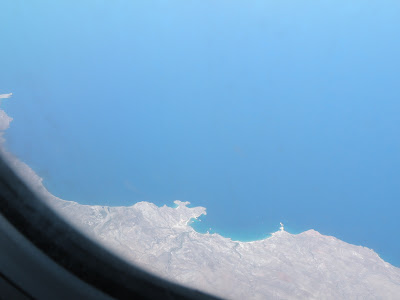
We took a Horizon Air flight from La Paz to LAX. The flightpath went up the spine of Baja, providing magnificent aerial views of some of our favorite anchorages. It was a nice review of our time in the Sea of Cortez.

Here is a shot of Bahia Amortajada (where we were attacked by jejenes)--it is the bay in the island on the left. The island on the right is Isla San Francisco, where we anchored in the famous "hook" after escaping the jejenes.

Here is a shot of Isla Carmen, east of Loreto, where we anchored in Balandro Cove, which can be seen on the left side of the island, and hiked to Bahia Salinas, on the right side--getting lost in the process.
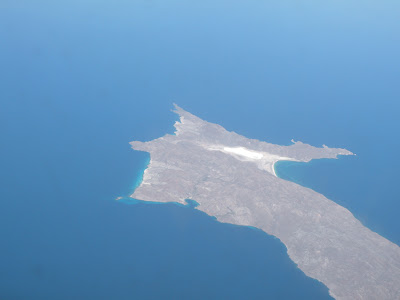
Here is Isla Coronados, where we climbed to the top of the extinct volcano.
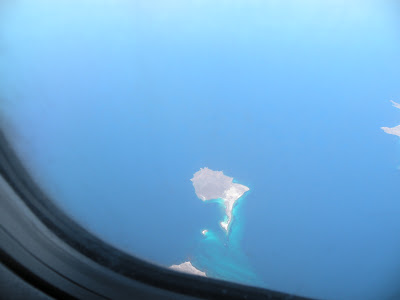
And here is Caleta San Juanico, our farthest stop north in the Sea of Cortez.

While in Southern California, I was able to attend an important meeting of the California Crime Laboratory Review Task Force, on which I serve. I also met with all of my graduate students and attended the UCI graduation ceremonies.

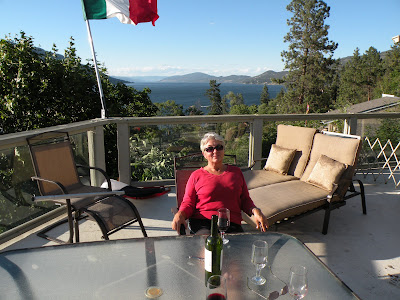
In light of the delays, Claudia and I decided to drive to Victoria rather than flying. Our son Elliot came along. We had a leisurely trip up the coast, visiting our son Graham in Santa Cruz, my sister Janet and husband Paul (who were crew members during the Baja HaHa) in Danville, and some of my favorite cousins in Ashland Oregon. We also got together with our daughter Jessica in Seattle. Then we drove to Kelowna, BC, where we were able to stay a few days with our friend Barry, who had sailed with us in Banderas Bay in January. Here is Claudia, sitting on Barry's deck, which overlooks Lake Okanagan.

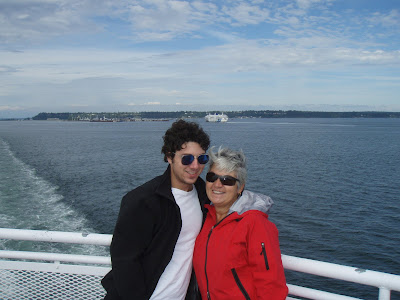
When it was finally time to pick up the boat, we drove to Vancouver, then took a ferry to Victoria. Here are Claudia and Elliot on the ferry.
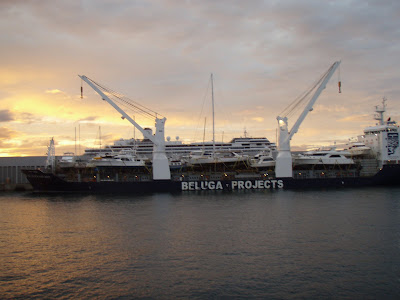
And here is the freighter, Beluga Fantasy, on which Sabbatical arrived, along with a number of other boats.

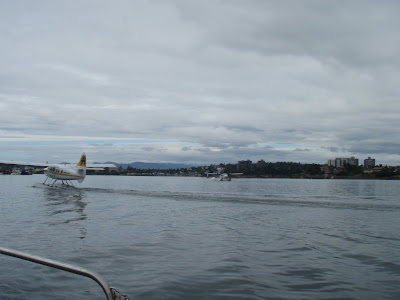
Sabbatical arrived intact, with no damage other than some minor chafing on the toerail from the straps used to hold her down. After Sabbatical unloaded, we climbed aboard, started the engine, and we motored into Victoria's Inner Harbor, dodging float planes on the way.

We stayed a couple of nights on docks right in front of the historic Empress Hotel in Victoria's Inner Harbor--a lively spot where we were entertained by buscars and street performers.
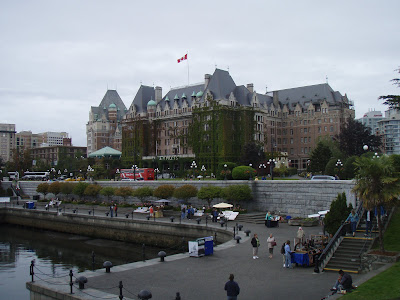

From Victoria, we headed north, beginning the Canadian portion of our sabbatical voyage.

Wednesday, June 2, 2010

Kayaking at Agua Verde; Lobster at Los Gatos; Jejenes at Amortajada


On May 26, we left Puerto Escondido in the afternoon and rode the falling tide south toward Bahia Agua Verde. Along the way we encountered a group of at least 20 dolphins, spread out in a line perpendicular to our course, heading toward us. They appeared to be on the hunt, allowing the tidal flow to sweep prey toward them. Having read that tuna sometimes hunt in this way with dolphins, I quickly tossed a Rapala lure in the water and within a minute had hooked this big skipjack, which provided tuna steaks for several lunches and dinners.
The next day at Aqua Verde, we kayaked into the beach and walked past some rather ominous looking buzzards to visit the small fishing village. It has one restaurant, two tiendas, and about 20 small houses--a remote and sleepy place. We bought a few supplies and chatted with the locals for a bit, before returning to the boat and continuing south to Bahia Los Gatos, where we anchored for the night.


Los Gatos is a beautiful anchorage. There appeared to be no one there, but the next morning we met Manuel, a local fisherman who is well known among cruisers as a source for lobster. Manuel was friendly and fun. He spoke very slowly and clearly, so that we could understand his Spanish, and asked many question about our boat and our travels. Eventually he asked us if we would like him to get some lobster for us. We told him that we needed to leave within one hour because we had a long trip to our next anchorage and we wanted to arrive before dark. It was then 11 am and we told him repeatedly that we would need to leave in one hour. He said there was no problem, and took off in his panga.
When Manuel had not returned after an hour and a half, we reluctantly weighed anchor and headed South. We wanted to make it to Bahia Amortajada before dark, so we needed to go. We were about an hour South of Los Gatos, making about five knots on a broad reach, when we looked behind us and saw a panga chasing us. It was Manuel, with the lobsters. We stopped until he caught up, feeling bit guilty for having left, but Manuel was smiling as he sold us his catch.
Late that afternoon we made it to Bahia Amortajada, a bay on Isla San Jose near a large lagoon and estuary. This bay is notorious for biting flies, but we thought we could rely on our good screens to keep them out. This was a serious mistake.

Just after sunset, as we were enjoying a lobster dinner inside the boat, Claudia and I both started feeling itchy. We could see no flies at first, but eventually began to detect tiny black spots, that looked like ground black pepper, on our skin. When we slapped at the specks, we noticed blood. We were under attack from the notorious Mexican jejenes, also known as "no seeums"--tiny blood sucking insects. They were so small that they came right through our screens. We put on long sleeved shirts and pants to try to keep them off, but it was no good. They crawled right under the clothing and more seemed to be arriving all the time. We began madly swatting them against the walls and ceiling of the cabin, where they left tiny smears of blood that they had sucked from us, but made no progress--more seemed to be entering the boat every minute. Finally, in desperation, we decided we had to leave. As quickly as possible, we started the engine, raised the anchor, and headed out of the bay, hoping to get away from them. But this required going outside, which at first made matters worse. Our screens seemed to have admitted only the tiniest jejenes. When we went outside we were attacked by their big brothers and sisters. The insect flew into our eyes, ears, nostrils and mouths, on the attack, biting everywhere. Eventually, after we were a mile or two off shore, the breeze cleared them away, but we were covered in bites. The red, itchy welts lasted for days.

Putting to sea after dark, in those reef strewn waters was a little frightening. As noted earlier, our chartplotter has not been accurate in this area and there are often differences between the charts and guidebooks over the position of reefs and shoals. Luckily, the moon rose, giving us a little light and helping us see the position of some of the more dangerous obstacles. I followed a weaving course, trying to steer only into areas where the charts and guidebooks agreed that I would find deep water, and keeping an eye on the depth gauge at all times. Eventually we worked out was through the reefs and down to Isla San Francisco, where we anchored inside the famous hook. As we were dropping anchor, we were hit by a powerful corumuel wind, of about 20 knots, which blew all night, sweeping away the last of the jejenes.

The next day we continued south--anchoring once again at Caleta Partida. Then it was on to La Paz, where we checked into Marina Palmira to wait for YachtPath.

Wednesday, May 26, 2010

Engine Repairs

On May 21st, we left Caleta San Juanico and headed south for Puerto Escondido, where we planned to resupply. Our last provisioning had been 12 days earlier, just before we left Puerto Escondido, and were were out of many essentials including ice, vegetables, beer, tortilla chips and liquor, and we were low on water.

The winds were from the southeast, so we began the trip by motorsailing directly into them, trying to get far enough east to be able to sail south toward Loreto. After about an hour, our engine overheated. When I stopped the engine to investigate, I discovered that the bolt holding the alternator bracket had sheared off. I tried to replace it with another bolt, but a broken piece of the original bolt was stuck inside the engine. I could not get it out and could not put in a new bolt because it was there. So there was no way to secure the alternator with a new bolt, which meant there was no way to tension the fan belt (which drives the water pump). I told Claudia the diesel engine was out of commission and we would have to sail to Puerto Escondido, where I knew we could find a mechanic.

Luckily, we were far enough east to be able to sail south toward Loreto, beating into the strong southeast breeze. We had to tack a bit to get far enough east to make our way around Isla Coronados, but we eventually made it down to Loreto, where we were able to establish an internet connection (using Telcel broadband) and send off an edited manuscript to my Swiss colleagues as we sailed past in the late afternoon.

As evening approached, however, the winds died. We were still several miles north of Puerto Escondido and were bobbing in the waves, going nowhere. Without an engine to take us into port, it looked like it might be a long night at sea.

We talked about using the dinghy and outboard to pull or push the boat, but before trying that I decided to look again at the engine and had an idea. Using twine, I managed to lash the alternator into place. This precarious repair allowed us to start the engine and make it into Escondido without overheating.


The good news was that, while motoring along slowly with the engine held together with twine, I managed to catch a 20 lb. skipjack tuna. It was a highlight of an otherwise frustrating day.

At Puerto Escondido, we were able to find a mechanic (Elvin on the vessel Sea Lover) who had the tools needed to extract the broken bolt from our engine block, so we were back in operation the next day.

We spent the following two days at beautiful Honeymoon Cove on Isla Danzante, which is only a few miles away from Puerto Escondido. Here is a picture of Sabbatical and the trawler Pacific in the cove.

On May 25th we ran out of propane and returned to Escondido to refill our propane bottle. We are there now, using the Singlar Marina WiFi connection to upload these blog posts. We plan to head south later this afternoon and work our way back to La Paz by next Sunday.

Caleta San Juanico


On May 15th, we left Isla Coronados and sailed north about 20 miles to Caleta San Juanico, a popular anchorage that is well-known among cruisers. On the shore of the wide, pretty bay is a tree that has become a kind of cruisers' shrine. Every boat that stops at San Juanico leaves a small notice of its passing on or near the tree. We saw notices from a number of boats we know, including Old Moon and the other Sabbatical. It is said that every boat that travels in the Sea of Cortez eventually stops in this anchorage.


Most of the notices are made of local materials, including sea shells that are found in great profusion on the beaches, and Apache Tears, which are shiny, black obsidian rocks that occur naturally here. We made a small notice on a shell and left it next to one from the other Sabbatical.

We stayed six days in San Juanico. I spent most of that time working on an article that I am co-writing with two Swiss collaborators. I received a draft from them over a Telcel Broadband link while sailing north past Loreto. I managed to revise the manuscript and send it back to them when we passed Loreto heading south on our return trip. Academic projects progress quickly when one has uninterrupted time.

But it wasn't all work. By taking apart the carburator and cleaning the needle valve, I managed to get the outboard motor working again. This allowed us to go out trolling at sunset. We only managed to catch one small reef fish, but it was very pretty.

While I was writing, Claudia spent a lot of time kayaking and snorkeling in the bay. She also collected some nice sea shells and some Apache Tears.

On May 18, for most of the day, we were the only boat in the bay. But it wasn't long before a number of other boats arrived, including our friends Liberty and Black Dragon. On May 20th there were ten boats here and the crew of Black Dragon arranged a beach party with a bonfire at sunset. We met a lot of interesting people, including Don and Linda from Iron Rose (based in San Diego), Irwin and J on Winsome, and Craig and Bruce on the catamaran Gato Go. It was a lively group.

We had one small scare while here. Just before the beach party, I was sitting in the cockpit, reading an article, when I heard the sound of pouring water inside the boat. I asked Claudia if she was running water in the sink. When she said she wasn't, I became alarmed. Investigation revealed that the drain pipe under our galley sinks had broken below the water line and sea water was pouring into the boat. We closed the sea cock, pumped out our bilge, and made repairs to the pipes. It was lucky we were aboard to catch this problem when it occurred. Although I had not noticed it before, some of the pipes under the sink are not marine grade fittings. They are household variety plastic pipes that are not suitable for a below-water-line application. Someone at some point had done a shoddy repair job on the sink. I plan to replace it all with proper marine-grade hoses as soon as possible. In the meantime, we'll close the sea cock whenever we leave the boat.

This marks our farthest venture north into the Sea of Cortez. From here we are turning around and heading south again, back to La Paz, where we will load Sabbatical on a YachtPath freighter for transport to British Columbia.